Monday, November 12, 2012
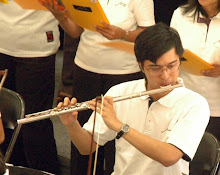
St. Laurentius Chamber Orchestra, 7 years of service
We started this group as a small chamber orchestra on August 2005. Over time, more and more people joined this orchestra, and the title "Chamber Orchestra" does not longer fit for its size.
Last August, 35 members of the Orchestra showcased an evening concert, performing all-time favourites from the classical music: Bach's Gavotte, Beethoven's Minuet in G, Schubert's Serenade, and similar compositions.
All of the works performed, were rearranged for a more complete instrumentation provided by the orchestra (many of the pieces were written for much simpler groups or even solo performance).
The program used solo performers accompanied by the orchestra, showing the character of individual instruments. Other than the obvious choice of using violin, cello, flute, and clarinet as soloists, the concert also performed some unusual solo instruments: the violin's cousin viola, and the double bass (showed in the picture, performing Beethoven's Moonlight Sonata)
Wednesday, April 28, 2010
Two movie soundtracks
It has been a while since the last update of this blog. I have been extremely busy lately, but here is some of my latest work, two short tunes I made for films. The first one was written for a short movie "Strangers", and used as the ending credit. It features a Ferry Matias at the cello. The film is directed by Marky Jahja Ali as a promotional video for a book by Farida Susanty.
OST-Strangers
The second one was written for a video art, a project by Andy Dewantoro. It is also directed by Marky. It is a simple piano tune used as the background music for the video. It is talking about the loneliness of old, abandoned buildings.
OST-Silentscream
OST-Strangers
The second one was written for a video art, a project by Andy Dewantoro. It is also directed by Marky. It is a simple piano tune used as the background music for the video. It is talking about the loneliness of old, abandoned buildings.
OST-Silentscream
Wednesday, May 6, 2009
ABRSM High Scorer Concert
The last time I checked, it is supposed to take approximately 2 weeks in UK to get the ABRSM exam result. Well, not here in Indonesia. I took the 5th grade theory exam, and I have to wait for almost eternity for the result. When it finally arrived, I had only 2 weeks left to register for the Grade 8 practical (the 5th grade theory is a prerequisite). Well, the deadline is just getting shorter.
After the Grade 8 practical, I have to wait another 3 months for the result, which is presented in just the examiner's comment sheet. Another 2 months passed, and I finally received the Grade 8 diploma. After still another 2 months (7 months from the exam), I received an invitation to join the high scorer concert. Registration deadline? 1 day. Great job!
In the High Scorer Concert, I'm supposed to play one of the exam piece that receives the highest score. Which one? Well, they told me which one to play, 3 days before the concert. So, they really do a marvelous job here. When they have to send something to the candidate, it takes forever. But when the candidate has to send something to them, they give a very short deadline.
Anyway, I'm going to perform JS Bach BWV 1035 for flute in Grand Serela, Bandung, this Saturday, 9 May 2009. My accompanist, Andrew Sudjana, has not recieved the score yet by the time of this writing. Classical music concert does not get any better than this.
After the Grade 8 practical, I have to wait another 3 months for the result, which is presented in just the examiner's comment sheet. Another 2 months passed, and I finally received the Grade 8 diploma. After still another 2 months (7 months from the exam), I received an invitation to join the high scorer concert. Registration deadline? 1 day. Great job!
In the High Scorer Concert, I'm supposed to play one of the exam piece that receives the highest score. Which one? Well, they told me which one to play, 3 days before the concert. So, they really do a marvelous job here. When they have to send something to the candidate, it takes forever. But when the candidate has to send something to them, they give a very short deadline.
Anyway, I'm going to perform JS Bach BWV 1035 for flute in Grand Serela, Bandung, this Saturday, 9 May 2009. My accompanist, Andrew Sudjana, has not recieved the score yet by the time of this writing. Classical music concert does not get any better than this.
Wednesday, March 18, 2009
Man vs Machine
I created a MIDI file to analyze a 1972 performance of Dave Brubeck Quartet. The song is the world-famous "Take Five", the tune that I took as a model for my irregular music. The spirit is simple, a complex rhythm does not have to sound difficult or even bizarre. It can sound astonishingly simple and pleasing. The result really is a timeless masterpiece.
Creating a MIDI file to mimic a real performance is definitely not possible with today's technology. Even the same human performer cannot repeat the performance exactly. It shows that music is more than just melody, rhythm, and harmony, all of which can be repeated or copied with almost surgical precision.
The precision, in fact, is one thing that separate us from machines. The subtlety of human-made imperfection in the intonation, rhythmic, or non-ideal timbre, is the thing that created the charm of a live music performance. Software synthesizers came up with solutions that basically try to put random imperfections at the MIDI output. However, the result is still unsatisfactory. There is something more than mere random imperfection.
The MIDI-generated music, with random dynamics variation and "swing" feel:
Take Five Synth.mp3
And the real performance by Dave Brubeck Quartet, for comparison
Take Five 72.mp3
Creating a MIDI file to mimic a real performance is definitely not possible with today's technology. Even the same human performer cannot repeat the performance exactly. It shows that music is more than just melody, rhythm, and harmony, all of which can be repeated or copied with almost surgical precision.
The precision, in fact, is one thing that separate us from machines. The subtlety of human-made imperfection in the intonation, rhythmic, or non-ideal timbre, is the thing that created the charm of a live music performance. Software synthesizers came up with solutions that basically try to put random imperfections at the MIDI output. However, the result is still unsatisfactory. There is something more than mere random imperfection.
The MIDI-generated music, with random dynamics variation and "swing" feel:
Take Five Synth.mp3
And the real performance by Dave Brubeck Quartet, for comparison
Take Five 72.mp3
Monday, March 2, 2009
Silversmithing
Boehm, the inventor of the flute, was known as a very fine flutist, composer, scientist, and a master silversmith.
Being a flutist, a composer, and a scientist already, I decided to take up the one last required skill, metal smithing.
So I made a trip to Kotagede, Yogyakarta with a friend of mine, Himawan, to learn this ancient craft in Studio76 under the guidance of Mr. Agus, a local silversmith. Kotagede is the center of Indonesian silver art, home to hundreds of craftsmen, located at the southern part of Yogyakarta. The first one from the left was a mobius ring made by Himawan. The other two are mine, a G-clef liontin and a ring.
So, while we're there, we decided to visit some architectural jewels of the city. The Tamansari Water Park (former residence of Mataram's Kings), the Kraton Yogya (current residence), and the megalitics structure scattered throughout the city, especially the Sewu Temple, Prambanan Temple, and the Ratu Boko Complex. We didn't have enough time to visit the famous Borobudur which is out of range of the city bus. The tour is completed by a trip to Dagadu (T-shirt factory) and a Batik gallery, and of course, "Gudek" for lunch.
Sunday, February 1, 2009
Sibelius 4 runs on Linux with wine 1.1.14
How great? Finally, the world's best notation editor runs on Linux! This program is the only one that keeps me rebooting back to Windows for a very long time. I'm still waiting for a Linux native notation editors. So far MScore and NtEd look promising, but they are still under heavy development, and it would take years for them to replace Sibelius, not mentioning another years for a converter that will allow me to open hundreds of my old .sib files.While sibelius 4 has been running on Linux for quite a while, the line break problem stops most people from runing it under Linux. The bug is, well, a bug. Minor, but annoying enough to render the software barely usable. Any text longer than one line will not render correctly, the software ignores the line breaks, so the all th
e lines will print one on another, making them impossible to read. To make things worse, it affects the time signatures, both numbers are printed on the same spot.But now, thanks to the wine developers, the bug is gone for good. You can see from the screenshot that the time signatures are printed correctly, with Compiz fusion's wiggly windows effect applied.
So finally, Linux becomes a usable platform for musicians. Currently my favourite software lists include JACK (Low latency audio connection kit), Ardour (digital audio worksation) and finally, a notation editor, the one and only Sibelius 4.
Sunday, January 18, 2009
Balinese Twins
My sister returned from Bali today, and as happens before, she brought a bamboo flute as a souvenir, and I already have an exactly the same model in my collection. So here they are, the Balinese twins

Most of these flutes are of tourist's quality. They do looks good but sounds awful. Well, I'm not talking about the sound quality as for traditional flutes, people takes breathyness and the lack of projection as a thing of beauty. But their intonation is so terrible that they can't play any comprehendsible tune.
From all 6, only the 4th and the 5th flute from the left has reasonable intonation. Still, their badly shaped flageolet and embouchure holes limit their overblowing capabilities. For the 1st two, their aspect ratio is just ridiculous, there is no way you can get correct intonation out of that, but somehow the Balinese are very fond of those fat flutes, and you can readily find them in their gamellan ensamble. Off course, I prefer the slender Sundanese flute supermodel.
The best one, not surprisingly the model similar to that played by many profesional balinese flutist, is the 4th. This is a very simple, small and lightly-decorated flute, but plays really well. It produces a very good pentatonic scale, allowing me to give an attempt to reproduce their music, with all the circular breathing extravaganza. And here is the sound recording of it:
Suling Bali.mp3

Most of these flutes are of tourist's quality. They do looks good but sounds awful. Well, I'm not talking about the sound quality as for traditional flutes, people takes breathyness and the lack of projection as a thing of beauty. But their intonation is so terrible that they can't play any comprehendsible tune.
From all 6, only the 4th and the 5th flute from the left has reasonable intonation. Still, their badly shaped flageolet and embouchure holes limit their overblowing capabilities. For the 1st two, their aspect ratio is just ridiculous, there is no way you can get correct intonation out of that, but somehow the Balinese are very fond of those fat flutes, and you can readily find them in their gamellan ensamble. Off course, I prefer the slender Sundanese flute supermodel.
The best one, not surprisingly the model similar to that played by many profesional balinese flutist, is the 4th. This is a very simple, small and lightly-decorated flute, but plays really well. It produces a very good pentatonic scale, allowing me to give an attempt to reproduce their music, with all the circular breathing extravaganza. And here is the sound recording of it:
Suling Bali.mp3
Subscribe to:
Posts (Atom)

